In this article
A checkpoint is useful when it lets you study one concrete sequence instead of treating the entire level as a reflex test. This guide looks at NEON START’s first checkpoint section, rather than repeat Arrow Fall’s general hold-and-release introduction.
Identify the section you are practising
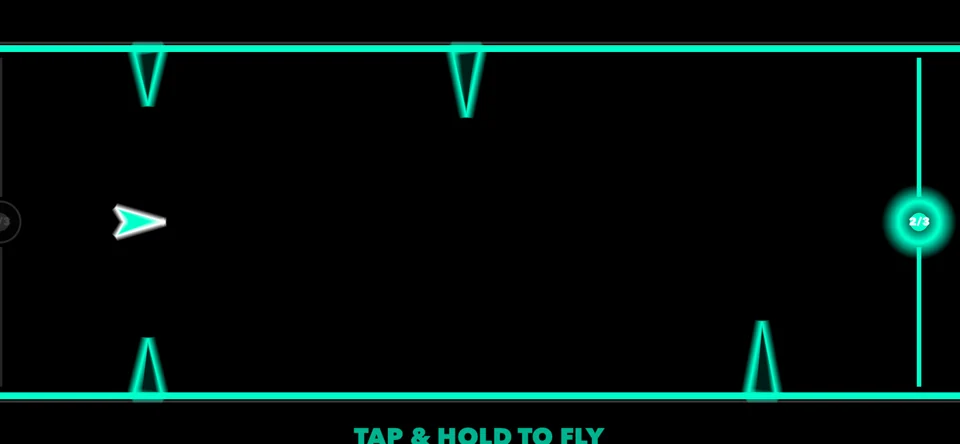
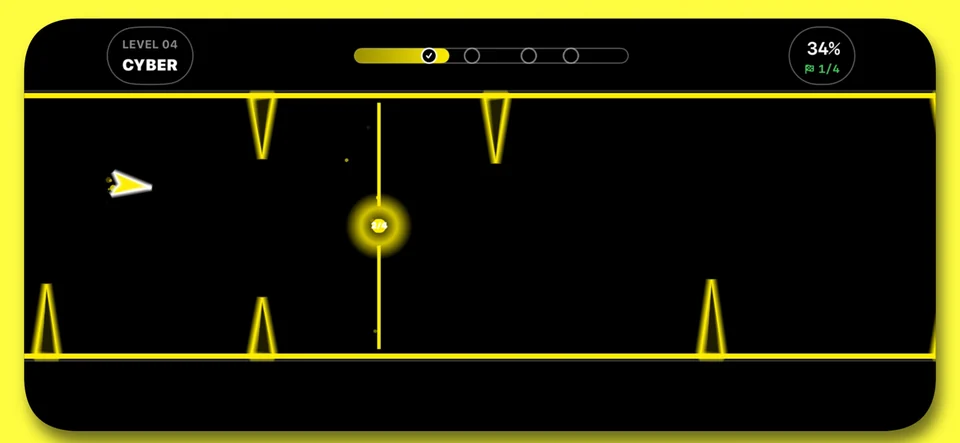
NEON START is the first released level. Its level data places the first checkpoint before a paired top-and-bottom obstacle. The paired obstruction is followed by a top spike and then a bottom spike before the next checkpoint.
The native scene image below was rendered from the app’s actual GameScene and level data with the first checkpoint marked reached in an isolated evidence runner. Advertising startup was disabled for that static render. It is a scene preview, not a claimed successful gameplay run or a recording of personal best times.
Prepare the central opening before arriving
A top-and-bottom pair leaves less room for a late extreme correction than a single spike. Look ahead and aim to arrive in the central space with a manageable vertical movement. Being centred for one instant is not enough if the arrow is already moving sharply towards the next boundary.
Use hold to rise and release to drop, but do not treat this article as a millisecond script. Entry height, vertical momentum, and when the input begins affect the route. I would first compare whether the collision came from entering too high, too low, or moving too strongly in one direction.
Plan for the alternating obstacles after the pair
The next top spike asks you to leave space below it. The bottom spike after that asks for the opposite clearance. A correction that barely saves the paired gap can therefore leave a poor approach for the next two hazards.
Change one action per attempt. For example, release earlier before the top spike while keeping the previous entry similar. Then check whether that change gives you enough room to rise before the bottom obstacle. If you change every hold and release at once, the next crash gives less useful information.
Give the practice a clear stopping rule
Try a small number of attempts with one observation in mind. Reaching the next checkpoint is a useful target, but it does not need to happen in a fixed number of tries. Stop when you no longer notice the movement you meant to compare.
The beginner guide covers the controls and checkpoint basics. For a different short activity, Pizple’s layout comparison and the shared-phone match schedule explain other games I build. The purpose here is understanding one route, not promising improved reflexes or a guaranteed completion.
Know the access limits
Arrow Fall is free to download with advertising and has 13 released playable levels. No in-app purchases are listed for this version. Checkpoints shorten the part of a level you need to replay; they are not a promise that every attempt or level will be easy.
Questions before you start
Should I copy an exact number of milliseconds for each hold?
No. Your approach and vertical movement matter. Compare a specific correction rather than assume one universal timing script.
Does the preview show a successful recorded attempt?
No. It is a native static scene render from the app’s actual level data, clearly separated from a gameplay result.
See the app details and current access information before choosing your next step.