In this article
An old journal entry can be useful precisely because it preserves what you thought before the outcome was clear. I would return to one reflection with a question to check, rather than skim a long history looking for proof that every day was an improvement.
Find a completed entry with something to revisit
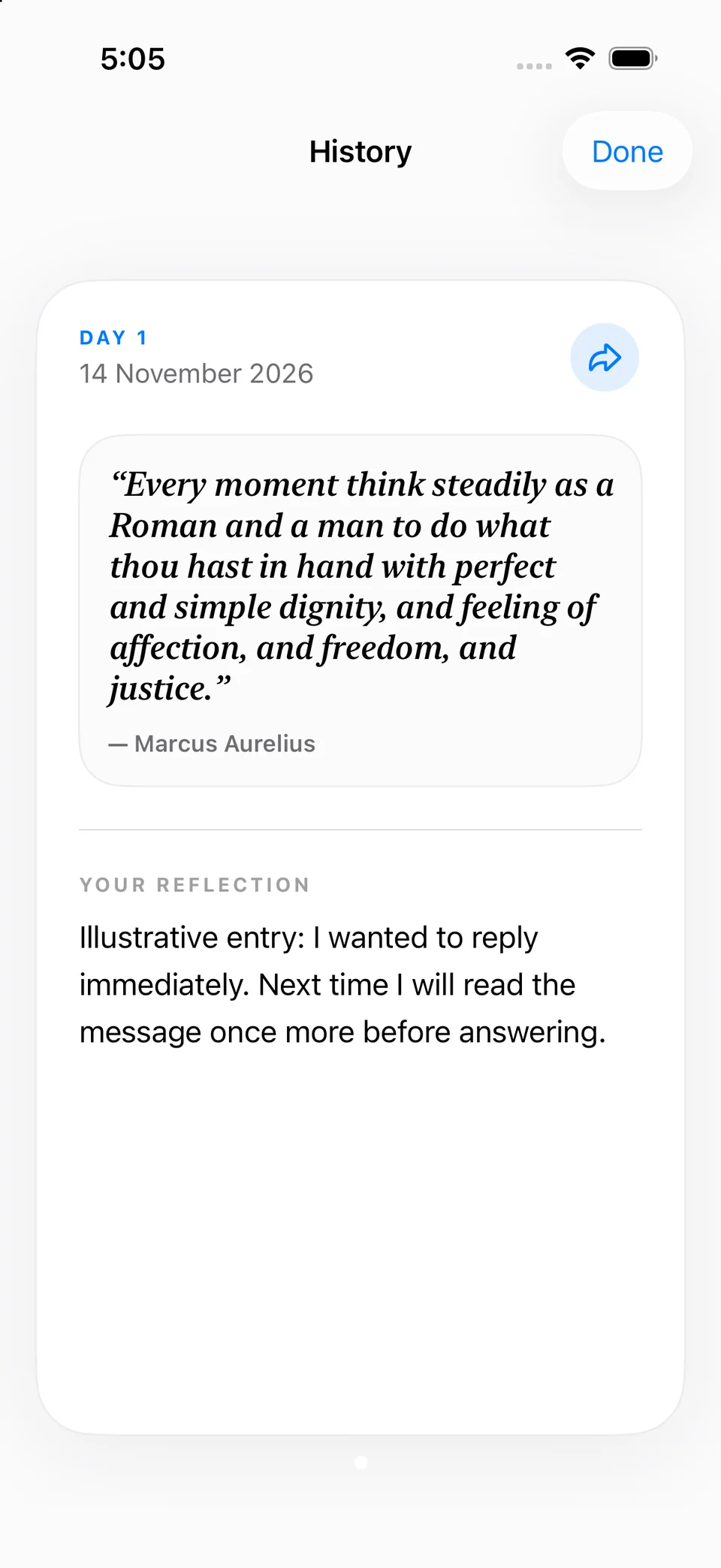
Open the reflection History view with the access it requires and move between completed entries. Read the day and date rather than assume the order is a calendar diary of every day you opened the app.
A day can be completed without writing a reflection. If an entry has no personal text, the completion record does not invent a missing paragraph. The screenshot below contains an explicitly illustrative entry created for this guide; it is not private customer writing or a claimed personal event.
Separate the passage, your note, and your new interpretation
Read the displayed passage, then the words you actually saved. The two are not interchangeable. A historical quotation, an editorial adaptation, and your own reflection each need their own attribution when shared.
For example, the demonstration entry says: “I wanted to reply immediately. Next time I will read the message once more before answering.” A useful follow-up is to ask whether you tried that pause. It is less useful to rewrite the old note in your mind as if you already knew how the conversation would end.
Choose an action small enough to observe
Write a separate follow-up in your current reflection or another note if the app’s available workflow does not edit the historical card. Do not assume that a history view offers a specific editing button merely because it displays your old text.
- Check the fact you said you would verify.
- Read the earlier message before replying again.
- Record that the issue remains unresolved.
These are my original prompts, not quotations from Marcus Aurelius or a therapeutic exercise. You do not need to force every entry into a positive lesson.
Keep the journal and any sharing deliberate
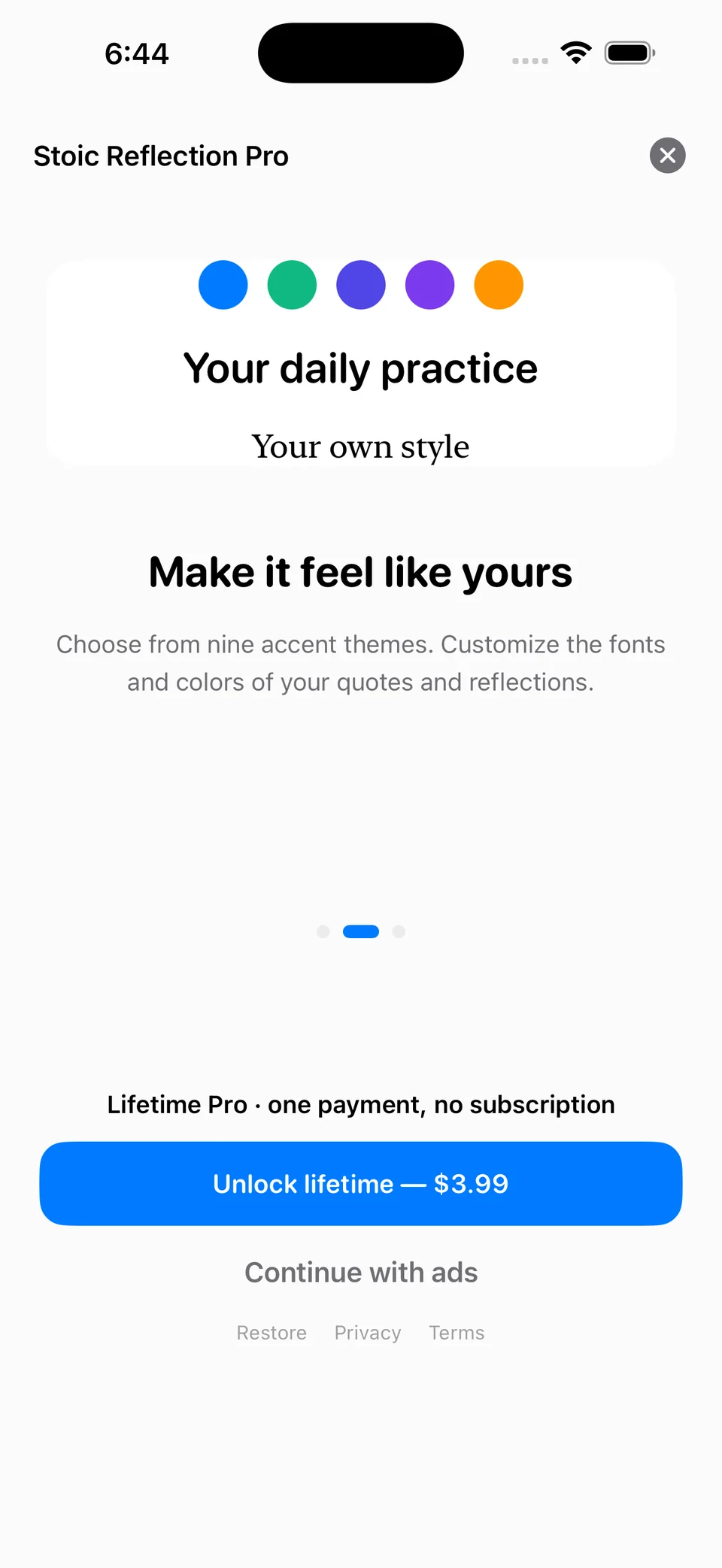
History is a Pro or active-trial feature; daily writing remains free. Before sharing a historical reflection, inspect the output for the passage wording, attribution, and personal details. Use your own judgment about who should see the note.
Check the quote’s source when attribution matters. The evening reflection guide starts a new entry, while the calendar guide explains reading progress. This article’s task is returning to a specific saved thought, not maintaining a perfect streak.
Know the access limits
Daily reading, guidance, written reflections, progress, and reminders remain free with ads. Pro removes ads and adds reflection history, full-path access, appearance, sharing extras, and Home Screen widgets. Eligible users can try Pro for seven days without automatic charging. Reflections stay on-device; keep separate copies of important writing before deleting the app or changing devices.
Questions before you start
Does a completed day mean I wrote a note?
No. The app allows completion without writing. Inspect the actual entry rather than infer text from the marker.
Can I read history after the free trial without Pro?
Reflection history requires Pro or an active trial. Daily reading and writing remain free with ads.
See the app details and current access information before choosing your next step.